Your website is, in a sense, your businesses frontline sales consultant, or at least it should be treated that way. Think about this: when you are talking to a sales consultant, what two things must be true for you to purchase off of them?
1. You trust this sales consultant. The consultant is honest, has no agenda and genuinely has your best interests at heart.
2. You like this sales consultant and he/she doesn’t frustrate you. You get along with the consultant on a personal level, reinforcing the fact that he/she isn’t all about the sale, but they are friendly and are actively trying his/her best not to inconvenience you.
These two things are just as important factors on your website, especially when it comes to improving website conversion rates.
So what are some things you can look at doing to improve your websites performance?
Obviously the best way to improve your sites conversion rate is to make a change and test and measure the response. However, certain changes can be risky and potentially harmful to the sites conversion goals.
There are so many low risk changes you can make on your site that have been proven to improve conversion rates in many cases. Some things to consider:
1. Are all elements on your site necessary? If not, remove them.
As a rule of thumb, the easier a site is on the eyes and the easier it is to navigate through the better. You don’t want to distract your visitor with confusing navigation and pointless elements competing for attention. Essentially, cluttered sites with confusing navigation will lose the visitors attention when the site really needs to be capturing it!
A good place to start looking for pointless elements is in your form elements.
People hate to fill out forms, so why make them fill out a long and convoluted form? Is all the information you’re requesting absolutely necessary or helpful to your goals? If not, remove it and your conversion rate will likely improve.
A good example of an often pointless form field is when you’re user is asked to divulge their gender. Is this helpful for you to know? Is it necessary to know? It could be. You may create targeted email marketing campaigns based on gender, or you want to know for future reference the ratio of male to female customers, and so on.
Obviously if there are no forms on your site, or you’re already asking for the bare minimum information, you need to start looking at other areas of your site instead.
Do you have too many calls to action? Do you have links that direct people away from your sites sale funnel? Are there distracting visual elements that don’t re-enforce the content of your site? All these things can lower conversion rates.
2. Do any of your pages take too long to load?
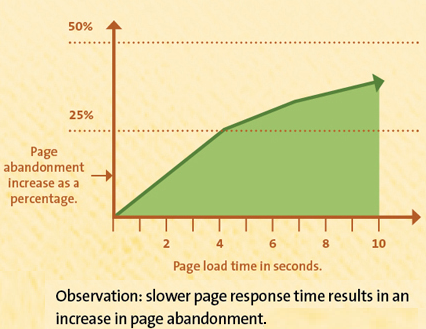
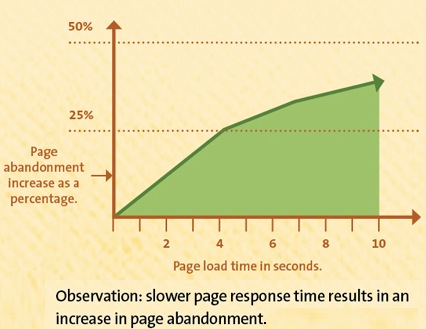
These days when it comes to websites, people have an attention span of between 4 and 7 seconds. If it takes a site longer than this to load, the bounce rate is probably going to be fairly high.
Recent studies have shown a distinct relationship between page load times and abandonment rates, as you can see in the following diagram: